When we talk about the Indian stock market, Sensex vs Nifty often becomes a common debate among new investors. These two are not just numbers moving up and down on TV screens — they are the heartbeat of India’s financial market. In simple words, Sensex and Nifty reflect how the overall stock market is performing. But do you know what makes them different? Let’s break it down in a simple, easy-to-understand way!
📊 Detailed Explanation with Simple Examples
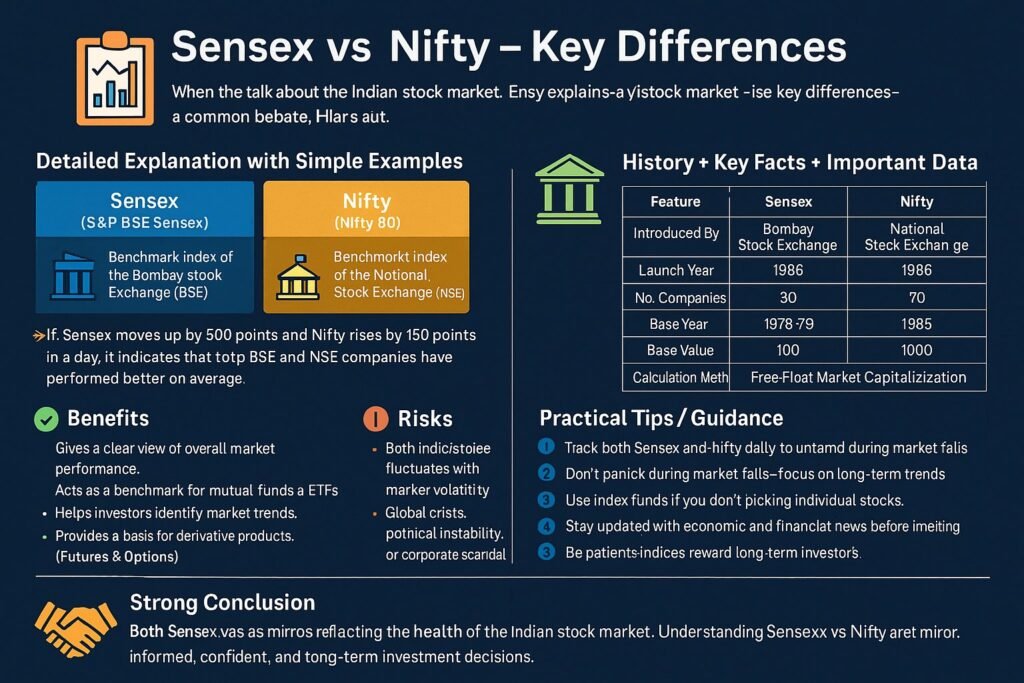
Sensex (S&P BSE Sensex) is the benchmark index of the Bombay Stock Exchange (BSE). It tracks the performance of the top 30 financially strong and well-established companies listed on the BSE.
Nifty (Nifty 50), on the other hand, is the benchmark index of the National Stock Exchange (NSE). It represents the top 50 companies across various sectors listed on NSE.
If the Sensex moves up by 500 points in a day, it means that the average value of those 30 BSE-listed companies has gone up. Similarly, if the Nifty rises by 150 points, it shows that the top 50 NSE-listed companies have performed better overall.
So, while both measure the stock market’s movement, they represent different groups of companies and exchanges.
🕰️ History + Key Facts + Important Data
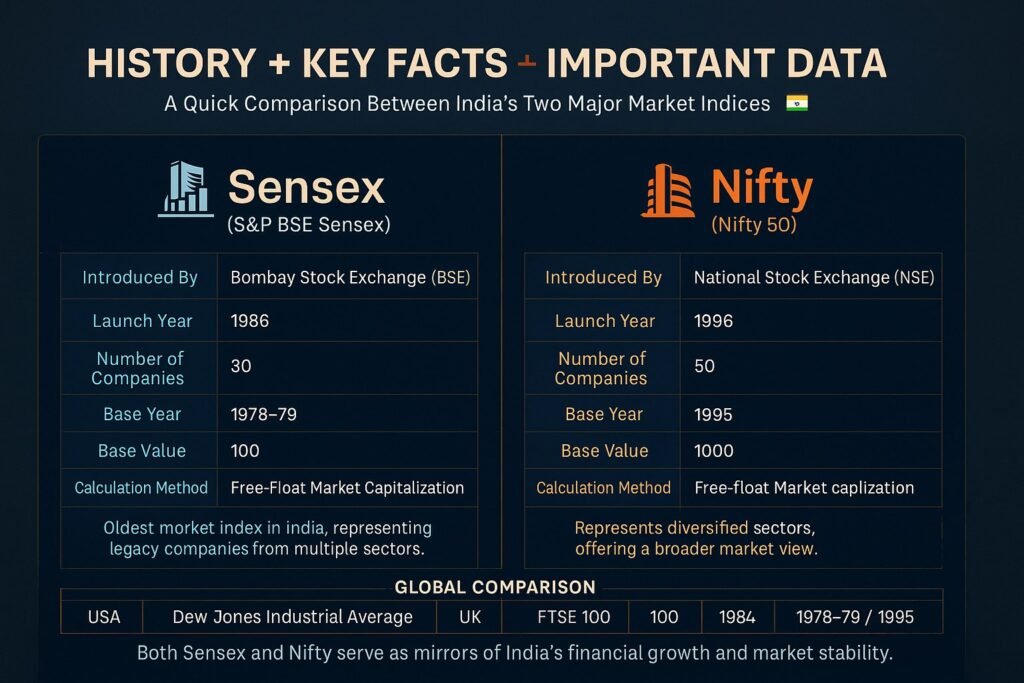
USA – Dow Jones Industrial Average (30 companies)
UK – FTSE 100 (100 companies)
Japan – Nikkei 225 (225 companies)
This shows that Sensex and Nifty are India’s versions of major global indices that track economic performance.
📘 Explanation of Important Terms / Concepts
Stock Index: A tool that tracks the performance of a selected group of companies’ stocks to represent the overall market trend.
Market Capitalization: The total value of all outstanding shares of a company.
Free-Float Market Cap Method: Only includes shares available for public trading (not promoter-held shares) to calculate index value.
Volatility: The rate at which stock prices rise or fall — both Sensex and Nifty are subject to it.
💰 Benefits + ⚠️ Risks
Gives a clear view of overall market performance.
Acts as a benchmark for mutual funds and ETFs.
Helps investors identify market trends.
Provides a basis for derivative products (Futures & Options).
Both indices fluctuate with market volatility.
A global crisis, political instability, or corporate scandal can affect them.
Short-term predictions can be misleading for beginners.
🧭 Practical Tips / Guidance
🪙 Track both Sensex and Nifty daily to understand how markets behave.
📈 Don’t panic during market falls — focus on long-term trends.
📊 Use index funds if you don’t want to pick individual stocks.
🧠 Stay updated with economic and financial news before investing.
⏳ Be patient — indices reward long-term investors.
- What is the main difference between Sensex and Nifty?
Sensex represents 30 companies listed on BSE, while Nifty represents 50 companies listed on NSE. - Which one is better for beginners?
Both are great for understanding market trends — Nifty covers more companies, while Sensex is older and well-established. - Can I invest directly in Sensex or Nifty?
No, but you can invest through index funds or ETFs that mirror their performance. - Why do Sensex and Nifty move together?
Because both represent India’s largest companies, their movements usually follow the same direction. - How often are the companies in Sensex or Nifty changed?
- The composition is reviewed twice a year to ensure that only the most relevant and liquid stocks remain part of the index.
🏁 Strong Conclusion
Both Sensex and Nifty act as mirrors reflecting the health of the Indian stock market. While Sensex focuses on 30 companies from BSE and Nifty covers 50 from NSE, both indices are equally crucial for investors, analysts, and policymakers.
Understanding Sensex vs Nifty – Key Differences not only builds your market knowledge but also helps you make informed, confident, and long-term investment decisions.