StocksKnow.com is your one-stop platform for everything about the stock market. From daily market updates and FII-DII trends to company earnings analysis and stock market basics, we provide clear, reliable, and easy-to-understand blogs.
Our goal is to help you learn, analyze, and grow as an investor or trader. Whether you’re a beginner exploring Nifty & Sensex for the first time or a market enthusiast tracking quarterly results, StocksKnow brings knowledge to your fingertips
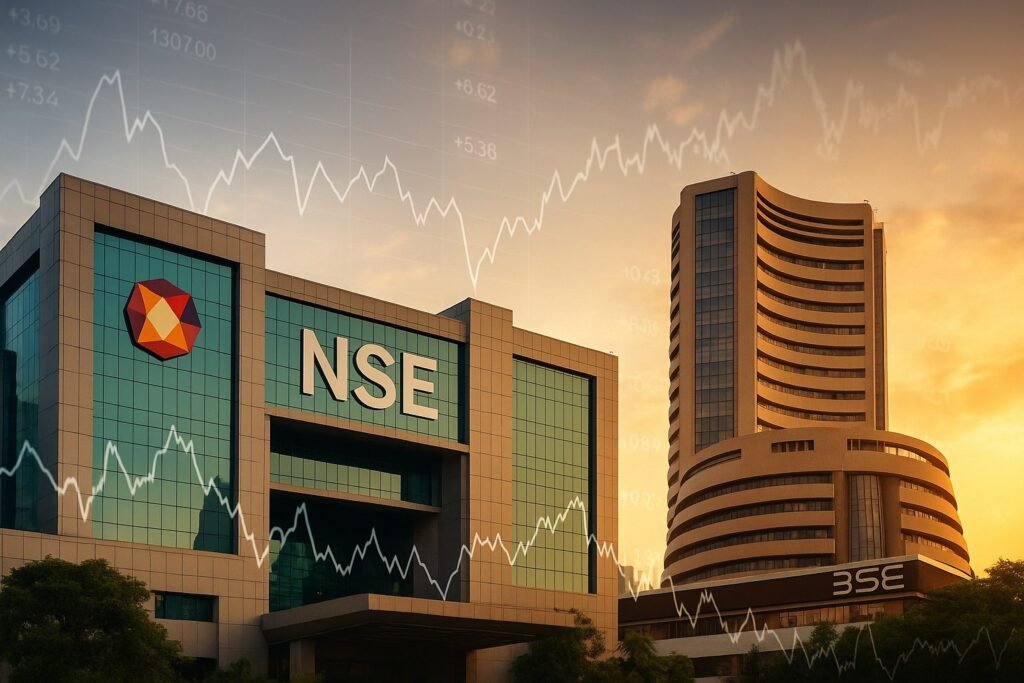
When we talk about the Indian stock market, two names always come up — NSE (National Stock Exchange) and BSE (Bombay Stock Exchange). These are not just random financial terms — they are the backbones of India’s capital market. Every stock trade you hear about — whether it’s Infosys, TCS, or Reliance — happens through these two exchanges.
If you’ve ever wondered what exactly NSE and BSE do, how they work, and which one is better for you as an investor — this blog will make everything crystal clear.
💡 Detailed Explanation with Simple Examples
Both NSE and BSE are platforms where buyers and sellers of shares meet electronically to trade.
NSE (National Stock Exchange): Established in 1992, NSE is India’s largest stock exchange by trading volume. Its flagship index is NIFTY 50, which represents the top 50 listed companies.
BSE (Bombay Stock Exchange): Founded in 1875, BSE is Asia’s oldest stock exchange and India’s first recognized exchange. Its benchmark index is SENSEX, consisting of 30 major companies.
Example: Let’s say you want to buy 10 shares of Reliance Industries. You can do it through either NSE or BSE — both platforms list the same stock but may show slightly different prices due to market activity.
Technology: First Indian exchange to offer fully automated electronic trading.
Fun Fact: NSE made trading faster, transparent, and accessible for small investors across India.
🕰️ BSE – The Historical Legacy
Established: 1875 (as “The Native Share & Stock Brokers’ Association”)
Recognition: India’s first stock exchange, officially recognized in 1957.
Main Index: SENSEX (introduced in 1986)
Global Recognition: BSE is among the top 10 stock exchanges globally by market capitalization.
🌍 World Context
While BSE is Asia’s oldest, NYSE (New York Stock Exchange) in the US is the largest in the world by market capitalization, showing how global stock markets operate on similar principles.
📚 Explanation of Important Terms
Term Meaning
Stock Exchange A marketplace where shares of listed companies are traded. Index A measurement of a section of the stock market. (e.g., NIFTY 50, SENSEX) Market Capitalization Total market value of a company’s outstanding shares. Demat Account A digital account to hold your shares electronically. Broker A registered intermediary who helps you buy/sell shares.
⚖️ Benefits & Risks
✅ Benefits:
Easy and quick online trading.
Transparent price discovery and real-time data.
Regulated by SEBI (Securities and Exchange Board of India) ensuring investor safety.
Access to hundreds of listed companies for diversification.
⚠️ Risks:
Market volatility can lead to sudden price swings.
Emotional trading (fear or greed) may result in losses.
Requires basic understanding of financial instruments before investing.
🧭 Practical Tips for Beginners
Start with Learning: Understand basic market terms before investing.
Open a Demat & Trading Account: Choose a reputed broker registered with both NSE & BSE.
Track Major Indices: Follow NIFTY and SENSEX daily to understand market trends.
Diversify Investments: Don’t put all your money in one stock.
Avoid Short-Term Panic: Stay patient — investing is about discipline, not emotion.
❓ FAQs
Q1: Which is better — NSE or BSE? Both are excellent. NSE has higher trading volumes, while BSE is known for its long history and legacy. Most brokers allow trading on both.
Q2: Can I buy shares from both exchanges? Yes, you can buy or sell shares on either exchange depending on availability and liquidity.
Q3: Is trading on NSE and BSE safe? Absolutely. Both are regulated by SEBI, ensuring investor protection and fair trading.
Q4: What are NIFTY and SENSEX? NIFTY (NSE) and SENSEX (BSE) are benchmark indices that reflect the performance of top companies listed on each exchange.
Q5: How can I check stock prices? You can check real-time prices on official websites — www.nseindia.com and www.bseindia.com.
In short, NSE and BSE are the twin pillars of India’s stock market, providing investors with transparent, regulated, and accessible platforms for trading.
If you’re a beginner, focus on learning how they work, follow NIFTY and SENSEX regularly, and gradually start investing with discipline.
Remember: The stock market rewards patience, not panic.
If you’ve ever heard about the Indian stock market, you must have come across two big names: NSE (National Stock Exchange) and BSE (Bombay Stock Exchange). These are the two main stock exchanges of India, where thousands of companies are listed and traded daily. For beginners, understanding the difference between NSE and BSE is the first step toward learning how the Indian stock market works.
What is NSE (National Stock Exchange)?
The National Stock Exchange (NSE) is India’s largest and most advanced stock exchange. Established in 1992, it introduced electronic trading in India for the first time. The main index of NSE is NIFTY 50, which represents the top 50 companies across different sectors.
👉 Example: If you buy shares of Infosys or Reliance on NSE, you are using a fully digital trading system.
What is BSE (Bombay Stock Exchange)?
The Bombay Stock Exchange (BSE), founded in 1875, is Asia’s oldest stock exchange. It is located at Dalal Street, Mumbai, and has a rich history in India’s financial market. The main index of BSE is SENSEX (Sensitive Index), which includes 30 top companies.
👉 Example: If you check the Sensex movement on news channels, you’re basically watching how the BSE market is performing.
History & Key Facts
BSE (1875): First stock exchange in Asia, officially recognized by the Government in 1957.
NSE (1992): Brought transparency with screen-based trading in India.
Global Position:
BSE is one of the fastest stock exchanges in the world with a speed of 6 microseconds.
NSE is ranked among the largest stock exchanges globally in terms of daily trading volume.
Important Terms to Know
Index: A benchmark that shows the performance of selected stocks (NIFTY 50 for NSE, SENSEX for BSE).
Listed Companies: Companies whose shares are available for public trading.
Market Capitalization: The total value of a company in the stock market.
Benefits of NSE & BSE
✅ Provide a transparent platform for buying and selling shares. ✅ Help companies raise capital from investors. ✅ Provide liquidity – you can easily buy/sell shares. ✅ Help measure the performance of the economy through indices.
Risks Involved
⚠️ Market fluctuations can cause losses. ⚠️ New investors may face challenges without proper knowledge. ⚠️ High volatility can impact short-term investments.
Practical Tips for Beginners
Start with paper trading (practice without real money).
Learn about indices (NIFTY, SENSEX) before investing.
Choose long-term investment over short-term speculation.
Always do research before buying stocks.
FAQs
Q1. Which is bigger, NSE or BSE? NSE is bigger in terms of trading volume, while BSE is older and has more listed companies.
Q2. Can I buy the same stock on both NSE and BSE? Yes, most companies are listed on both exchanges, so you can buy from either.
Q3. What is the difference between Sensex and Nifty? Sensex = Top 30 BSE companies, Nifty = Top 50 NSE companies.
Q4. Is investing in NSE and BSE safe? Yes, both are regulated by SEBI (Securities and Exchange Board of India).
Conclusion
Both NSE and BSE play a crucial role in India’s financial growth. NSE is known for modern digital trading, while BSE is respected for its historic legacy. For beginners, understanding both exchanges helps in making smarter investment decisions.