🌟 Introduction
The stock market may appear filled with charts and financial terms, but its core idea is very simple: companies raise money by offering shares, and investors buy those shares to participate in their growth. Understanding this system is the first step for any beginner who wants to explore wealth creation through investing.
🏛 What Exactly is the Stock Market?
A stock market is not a single place but a network of exchanges where ownership in companies is traded. In India, the two main exchanges are:
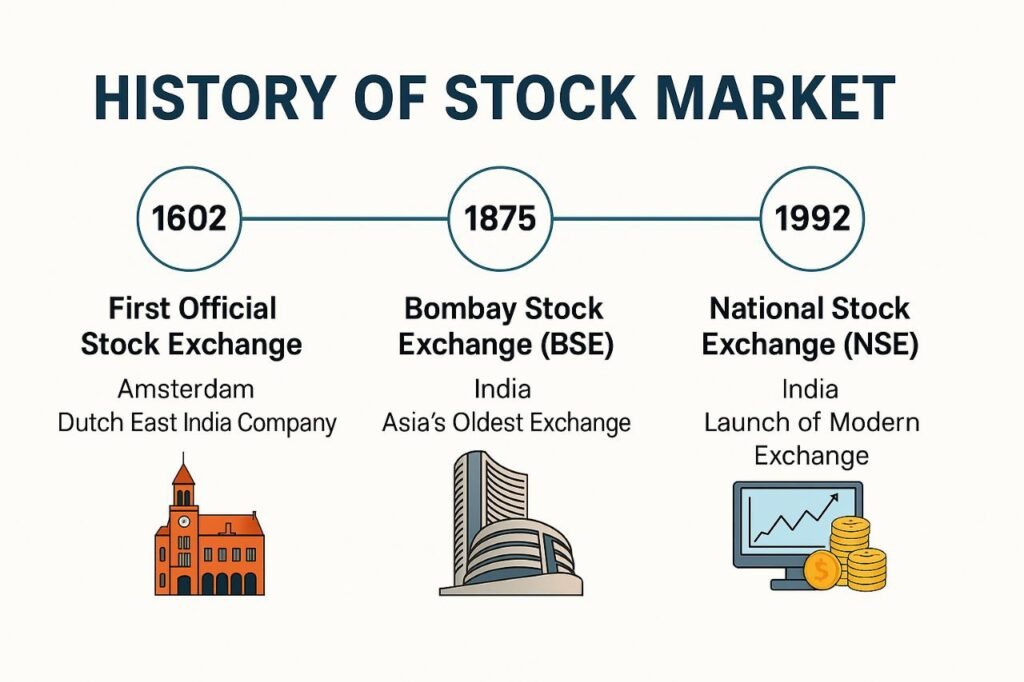
NSE (National Stock Exchange) – Established in 1992, it introduced electronic trading and made investing easier for everyone.
BSE (Bombay Stock Exchange) – Founded in 1875, it is the oldest stock exchange in Asia, with a rich history spanning more than a century.
These exchanges provide a regulated, transparent, and secure environment for trading.
🌍 Global Origins of Stock Markets
The world’s first organised stock market began in Amsterdam in 1602, when the Dutch East India Company issued shares to the public.
The New York Stock Exchange (NYSE) was formed in 1792 when 24 brokers signed the Buttonwood Agreement.
The London Stock Exchange (LSE) started formal operations in 1801 and remains one of the most important global markets.
🇮🇳 History of the Indian Stock Market
1830s: Share trading informally began under banyan trees in Mumbai.
1875: Establishment of the Bombay Stock Exchange (BSE).
1956: BSE became the first recognized exchange under the Securities Contracts Regulation Act.
1992: NSE (National Stock Exchange) was founded, introducing electronic trading.
1992: SEBI (Securities and Exchange Board of India) received statutory powers to regulate the market and protect investors.
1986: The SENSEX (BSE index) was launched with a base value of 100 points, and today it trades in tens of thousands.
👉 As of 2025, India’s stock market is the fifth largest in the world by market capitalization.
📊 Key Stock Market Terms Every Beginner Should Know
- Share/Stock – A unit of ownership in a company.
- IPO (Initial Public Offering) – The first time a company offers its shares to the public.
- Index – A benchmark that tracks the performance of selected stocks (e.g., NIFTY 50, SENSEX).
- Bull Market – A period when prices rise consistently.
- Bear Market – A period when prices fall consistently.
- Dividend – Profit shared by the company with its shareholders.
📌 Interesting Facts About Stock Markets
Warren Buffett, one of the world’s most successful investors, bought his first stock at 11 years old.
The Dow Jones Industrial Average (DJIA), created in 1896, is the oldest U.S. stock index still in use.
India’s NIFTY 50 index was launched in 1996 with a base value of 1000 points.
Stock markets are highly influenced by global events, from wars to elections, making them dynamic and unpredictable.
🔑 Why Should You Invest in Stocks?
Potential for higher returns compared to savings accounts or fixed deposits.
Helps fight inflation in the long run.
Ownership in top-performing companies.
Easy to buy and sell, offering liquidity.
⚠️ Risks You Must Know
Market fluctuations can cause short-term losses.
Poor company performance may reduce share value.
Emotional investing or following rumors often leads to mistakes.
📘 Practical Tips for Beginners
✔️ Begin with small investments instead of putting in a lump sum.
✔️ Focus on learning — read about companies and market basics.
✔️ Diversify investments to reduce risk.
✔️ Avoid blindly following tips or herd mentality.
✔️ Try paper trading first to practice without losing real money.
❓ FAQs
Q1: When did India’s stock market start?
👉 In 1875, with the creation of BSE in Mumbai.
Q2: Which is Asia’s oldest stock exchange?
👉 The Bombay Stock Exchange (BSE).
Q3: Is stock market the same as gambling?
👉 No. While gambling depends on luck, the stock market depends on company performance, economy, and informed decisions.
Q4: Can I start with a small amount?
👉 Yes. You can begin investing with as little as ₹500–₹1000 through brokers and apps.
📝 Conclusion
The stock market has evolved from open-air trading under trees in the 19th century to today’s digital platforms. For beginners, knowing the history, terms, benefits, and risks is the foundation of successful investing. Remember — every expert was once a beginner who took time to learn before making smart choices.