Introduction
When people hear the term stock market, they often think of buying and selling shares. But in reality, the stock market has two important segments: the Primary Market and the Secondary Market. Understanding the difference between these two markets is the first step for any beginner investor.
What is the Primary Market?
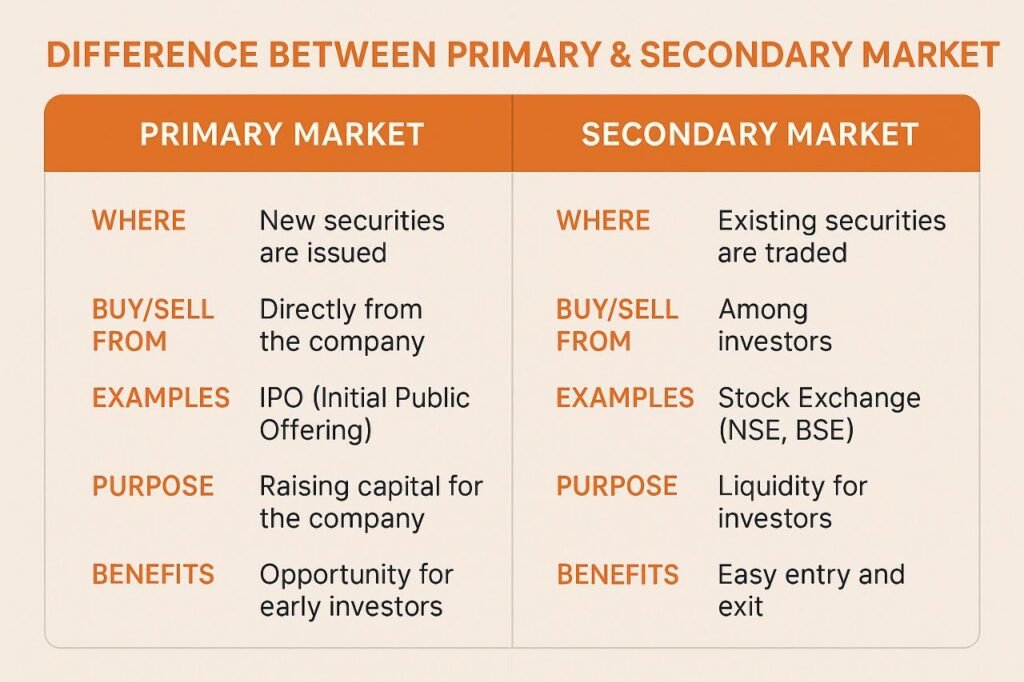
The Primary Market is where companies raise money by issuing new securities (shares, bonds, etc.) to the public for the first time.
The most common example is an IPO (Initial Public Offering).
Here, investors directly buy from the company, and the money raised goes to the company for expansion, debt repayment, or growth.
📌 Example: When LIC launched its IPO in 2022, it was part of the Primary Market.
What is the Secondary Market?
The Secondary Market is where already issued securities are traded between investors.
This is what we commonly call the Stock Exchange (NSE, BSE in India).
The company does not receive any money here; instead, one investor sells to another.
📌 Example: If you buy Tata Motors shares from NSE today, you are participating in the Secondary Market.
History & Key Facts
📌 Primary Market in India: The first IPO in India is considered to be from Reliance Industries (1977).
📌 Secondary Market in India: The Bombay Stock Exchange (BSE), established in 1875, is Asia’s oldest stock exchange.
📌 Globally: The New York Stock Exchange (NYSE) is the world’s largest stock exchange (founded in 1792).
Key Terms You Must Know
IPO (Initial Public Offering): First-time sale of shares to the public.
FPO (Follow-on Public Offer): When a company issues more shares after IPO.
Stock Exchange: Platform where secondary market trades happen (NSE/BSE).
Liquidity: Ability to quickly buy/sell securities in the secondary market.
Benefits & Risks
✅ Benefits of Primary Market
-Direct investment in company growth
-Opportunity to buy at the base price
-Transparent allotment system
-❌ Risks of Primary Market
-Uncertainty about company’s future performance
-IPOs may be overvalued
✅ Benefits of Secondary Market
-High liquidity (easy buy/sell)
-Price discovery based on demand & supply
-Opportunity for both short-term and long-term gains
-❌ Risks of Secondary Market
-Market volatility can lead to losses
-Requires continuous monitoring and research
Practical Tips for Beginners
- Always read the company’s financials before applying in an IPO.
- In secondary markets, use stop-loss to manage risk.
- Avoid investing based only on tips—do your own research.
- Diversify across multiple stocks/sectors.
FAQs
Q1. Can I sell IPO shares immediately after allotment?
👉 Yes, but only after the stock is listed on the stock exchange.
Q2. Which is safer: Primary or Secondary Market?
👉 Primary market IPOs carry uncertainty, while the secondary market carries volatility. Both have risks—choose based on your risk profile.
Q3. Is Demat Account required for IPO and stock trading?
👉 Yes, a Demat and trading account is mandatory for both.
Q4. Why do companies issue shares?
👉 To raise funds for expansion, debt repayment, and new projects.
Conclusion
The Primary Market is where companies raise money, while the Secondary Market is where investors trade among themselves. Both markets are equally important for the economy and for investors. A smart investor must understand the difference, risks, and opportunities before entering.
💡 Enhanced Knowledge: Did you know? In India, over ₹1.6 lakh crore was raised through IPOs in FY2021–22, marking one of the biggest years for the Primary Market in history.